


Most standard grid-connected solar panel systems do not power your home during a power cut. Adding a battery does not automatically change that: backup requires compatible equipment and a system designed and configured for it.
If you are considering solar panels or battery storage for your home in Greater Manchester or the North West, ask about backup before accepting a quotation. Storing electricity to use in the evening and supplying your home when the grid fails are different requirements.
Why don’t ordinary solar panels work during a power cut?
The Energy Saving Trust’s solar fact check explains that typical solar installations cannot supply a home during an outage without additional equipment. It also notes that batteries normally need extra equipment and configuration to provide backup.
Grid-connected equipment must respond safely when the mains supply fails. A backup installation needs a suitable arrangement to separate the supported supply from the grid. This is a system design question for your installer; it is not a setting to assume you can enable later.
Will a solar battery keep the lights on?
Only if backup is supported by both the equipment and the installation. A quotation describing a “hybrid inverter” or “battery-ready system” does not, by itself, confirm what will work during an outage.
Ask for a written description of the backup arrangement. It should identify the circuits or outlet supplied, power limits, switching behaviour and any extra installation work. Also ask whether the proposed system needs manual operation or changes over automatically.
Essential circuits or whole-home backup?
Start by listing what matters to you. Lighting, a fridge, phone charging and a broadband router may be priorities. Supplying an electric shower, EV charger or electric heating creates a different demand.
- Selected circuits: the design supports an agreed part of your home. Confirm exactly which sockets, lights and appliances are included.
- Broader home backup: a suitable design may support more of the property, but equipment limits still apply.
- Dedicated backup outlet: some proposals provide a specific outlet rather than supplying your existing household circuits. Ask how it is intended to be used.
“Whole-home” does not mean unlimited power. Your installer should explain which appliances can run together and how starting loads affect the design.
How long would a battery last in a power cut?
Two separate figures matter: energy in kWh and power in kW. Energy describes how much is available; power describes the rate at which the system can supply it.
As a simplified example, if 4 kWh were available to the supported circuits and their average demand were 0.5 kW, the arithmetic would be 4 ÷ 0.5 = 8 hours. This is an illustration, not a runtime promise. Conversion losses, system consumption, battery reserve settings, temperature and changing appliance demand can reduce the result.
The charge remaining when the outage begins matters too. A battery that has already supplied your evening electricity may have much less energy available than its advertised capacity. Ask how maintaining a backup reserve would affect everyday use.
Can solar panels recharge the battery while the grid is down?
That depends on the complete system. Do not assume it because panels and a battery are both present. Ask whether solar generation remains available in backup mode and what happens when the battery is full or very low.
For a manufacturer example, Tesla’s UK Powerwall guidance explains that solar recharging during an outage depends on configuration. It also describes how appliance demand and available charge affect backup duration. Those details should not be treated as specifications for another battery brand or a different installation.
Questions to ask before buying battery backup
- Does this exact quotation include functioning backup, or storage for normal grid-connected use only?
- Which circuits or outlet will be supplied?
- What are the continuous power and starting-load limits?
- Is changeover automatic, and is there an interruption?
- Can solar recharge the battery during an outage?
- How much usable energy will remain at my chosen reserve setting?
- What extra equipment, electrical work and commissioning are included?
- How will backup operation be demonstrated at handover?
Use these alongside our solar quote comparison checklist when comparing proposals. Clear answers are more useful than a general promise of “energy independence”.
Common questions about solar panels in a power cut
Will my Wi-Fi work if the battery powers the router?
Your router needs a supported electricity supply, but internet access also depends on your provider’s network. Powering the router does not guarantee the external connection will remain available.
Can backup be added to an existing solar system?
It may be possible, but compatibility and the electrical installation need assessment. Share the inverter and battery model numbers, installation documents and your backup priorities with the installer before asking for a firm price.
Does a larger battery guarantee better backup?
No. Capacity, available charge, power output and the circuits included all matter. A larger battery without a suitable backup arrangement will not meet the same need as a system designed for outages.
Discuss solar and battery storage for your home
Flux Solar Energy is based in Westhoughton and serves Greater Manchester and the North West. Explore our solar panel and battery installation services or request your free solar quote. Tell us whether your priority is using more solar electricity, managing bills or discussing backup for particular appliances.
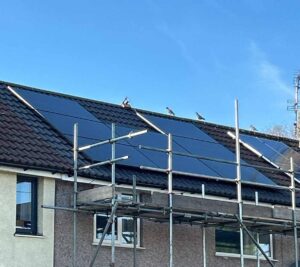
The photograph shows a Flux inverter and battery installation in Wigan. It illustrates installed equipment and does not establish that backup is included in that system.