

The New Era of Home Energy: Why Solar is the 2026 Standard
Something fundamental has shifted in how British homeowners think about energy. It’s no longer simply a utility bill to be managed — it’s a resource to be generated, stored, and sold back to the grid. In 2026, solar panel installation has moved decisively from eco-conscious aspiration to sound financial strategy.
The numbers tell a compelling story. With UK electricity prices remaining elevated and the government’s Warm Homes Plan channelling investment into domestic energy upgrades, the case for generating your own power has never been stronger. Pair that with the Smart Export Guarantee (SEG) — which requires licensed energy suppliers to pay homeowners for surplus electricity exported to the grid — and the financial equation looks markedly different from even three years ago.
Smart Export Guarantee (SEG): A UK government scheme requiring energy suppliers with 150,000+ customers to offer export tariffs, paying homeowners a per-unit rate for excess solar energy fed back into the National Grid.
The market itself reflects this shift. The default installation in 2026 is no longer panels alone. Solar-plus-battery storage has become the new baseline expectation, allowing households to capture daytime generation and deploy it during peak evening hours — dramatically reducing dependence on grid electricity and maximising returns on every unit produced. What was once a premium add-on is now a core component of any serious installation.
Perhaps most importantly, the framing around professional installation is changing. Savvy homeowners are no longer asking “How do I minimise the cost of going solar?” — they’re asking “How do I maximise the return on this investment?” That’s a fundamentally different question, and it demands a fundamentally different approach.
Professional installation isn’t simply a regulatory requirement; it’s a value driver that determines system performance, warranty validity, and long-term savings.
Understanding exactly what that value is worth — and what it costs — is where the real strategic picture begins to take shape.
The Financial Blueprint: Costs, Savings, and the 2026 ROI
Understanding the numbers behind solar panels for home installation is where strategic thinking separates confident buyers from hesitant ones. The financial case in 2026 is genuinely compelling — but only when you account for the full picture, including the costs that rarely appear in a headline quote.
What a System Actually Costs in 2026
UK installation prices have stabilised considerably following the supply chain turbulence of earlier years. As a general benchmark:
4kW system: £5,000–£7,000 fully installed, suitable for a smaller semi-detached or household of 2–3 people
6kW system: £7,500–£10,000 fully installed, better suited to larger detached homes with higher consumption
These figures represent supply and installation but do not automatically include battery storage, which adds a further £2,500–£5,000 depending on capacity. The cost per watt has dropped significantly over the past decade — research into solar panel ROI consistently shows that today’s buyer is getting substantially more output per pound spent than at any previous point.
0% VAT and Available Funding
One of the most tangible policy benefits available to British homeowners is the 0% VAT rate on residential solar installations, which has been maintained into 2026. On a £7,000 installation, that represents a saving of £1,400 compared to the standard 20% rate — a meaningful reduction that many homeowners overlook when comparing quotes.
Beyond VAT, the Great British Insulation Scheme and select local authority grant programmes continue to offer targeted support, particularly for households in lower EPC-rated properties. Eligibility criteria vary, so it’s worth checking current provision with your local council before committing.
Calculating Your Payback Period
Smart Export Guarantee (SEG): A UK government-backed scheme requiring licensed energy suppliers to pay homeowners for surplus electricity exported back to the national grid, providing an ongoing income stream from unused solar generation.
A realistic payback period for a well-specified system sits between 7 and 11 years, depending on tariff rates, household consumption patterns, and SEG payments received. The calculation works on two parallel tracks:
Direct savings — electricity you generate and use yourself, displacing grid imports at current unit rates (typically 24–28p per kWh)
SEG income — payments for surplus exported electricity, currently ranging from 4p to 15p per kWh depending on your supplier
A 4kW system generating around 3,400 kWh annually in southern England could realistically save £800–£1,000 per year when both streams are combined. Over a 25-year panel lifespan, that represents a substantial return.
The Hidden Costs Worth Budgeting For
Transparent financial planning means accounting for costs that frequently surprise homeowners post-installation:
Scaffolding: Often charged separately, typically £300–£600
Structural survey: Required for older properties or unusual roof configurations, £150–£400
Inverter replacement: Inverters typically carry a 10–12 year warranty and cost £500–£1,500 to replace — a near-certain expenditure within the panel lifespan
Factor these in from the outset and your ROI projection remains realistic rather than optimistic.
Once the financial foundation is clear, the next logical step is ensuring your property is physically optimised to deliver on that return — and that begins with a thorough assessment of your roof.
Table of Contents
Shading Analysis: Where Micro-Inverters and Optimisers Earn Their Cost
Commissioning and MCS Certification: Never Skip the Paperwork
Planning Your Home Solar Electric System
With the financial case for solar firmly established, the next critical step is assessing whether your home is physically ready to deliver on that promise. Effective planning separates installations that perform at peak capacity for decades from those that consistently underdeliver — and it begins long before any panel touches your roof.
Roof Orientation and Pitch: South Isn’t the Only Answer
The conventional wisdom that only south-facing roofs are viable for solar has become outdated. South-facing roofs at a pitch between 30° and 40° remain optimal for maximum annual yield, but east-west configurations are increasingly popular — and for good reason. An east-west split across a dual-pitched roof can generate a more consistent energy output throughout the day, reducing reliance on the grid during morning and evening demand peaks. In practice, a well-designed east-west system can achieve 85–90% of the output of a south-facing equivalent, while covering a larger roof area and distributing weight more evenly.
Understanding the ’20 Rule’ for Panel Efficiency
The ’20 Rule’: Solar panels should not cover more than 20% of a roof surface without detailed structural assessment, ensuring adequate spacing for ventilation, maintenance access, and thermal regulation.
Proper spacing between panels isn’t merely a planning formality — it directly affects performance. Panels that trap excessive heat beneath them experience thermal degradation, reducing their efficiency by as much as 0.5% per degree Celsius above 25°C. When planning solar panels and installation, your installer should calculate optimal array spacing based on your specific panel specifications and roof geometry, not simply maximise panel count.
Shading Analysis: Where Micro-Inverters and Optimisers Earn Their Cost
Shading analysis is the process of mapping shadows cast by chimneys, dormers, trees, and neighbouring structures across your roof throughout the year. Even partial shading on a single panel can reduce the output of an entire string in a traditionally wired system — a disproportionate performance penalty.
Micro-inverter: A small inverter fitted to each individual panel, converting DC to AC power at source, so one shaded panel cannot drag down the output of others.
Power optimisers offer a middle-ground solution, conditioning the DC output of each panel before feeding into a central inverter. Both technologies add upfront cost but consistently deliver stronger returns on roofs with any degree of partial shading.
Structural Integrity: Your Roof Must Carry the Load
Dead load — the static weight of the panel array, mounting rails, and fixings — typically adds 15–25 kg per square metre to your roof structure. Homes built before the 1970s, or those with signs of sagging, damaged rafters, or deteriorating felt, require a professional structural survey before any installation proceeds. Skipping this step risks voiding your building insurance and, more critically, compromising the safety of your home.
Getting the planning stage right determines everything that follows — including how smoothly your installation day unfolds.
The Installation Process: What to Expect on Day One
Once your home assessment is complete and your installer has confirmed suitability, the physical work begins — and it moves faster than most homeowners expect. Installing solar panels for your home typically takes just one to three days on-site, but the weeks of planning, surveys, and approvals preceding that moment are where the real groundwork is laid.
The Timeline: Planning vs. Physical Installation
The gap between “yes, I want solar” and a live system is typically four to eight weeks. This window covers your detailed roof survey, structural calculations, equipment ordering, and — crucially — any necessary notifications to your Distribution Network Operator (DNO). For systems over 3.68kW, DNO approval is a legal requirement before commissioning can proceed. Rushing this stage is one of the most common reasons installation projects stall at the final hurdle.
DNO Notification: A formal process by which a homeowner’s installer informs the local electricity network operator of a new generation source being connected to the grid. Required for most domestic solar installations in the UK.
Once approvals are in place, the on-site timeline typically looks like this:
Day 1 – Scaffolding and roof preparation: Access scaffolding is erected, roof tiles are lifted where necessary, and anchor points (also called penetration mounts) are fixed securely into the rafters. Waterproofing flashings are fitted around each mount.
Day 1–2 – Rail mounting and panel fixing: Aluminium mounting rails are bolted to the anchors, creating the structural framework. Individual panels are then clipped and clamped into position along the rails. A competent team can fit a standard 12–16 panel array in a single day.
Day 2 – The electrical handshake: DC cabling from the panels is routed to the inverter — the device that converts raw solar electricity into usable AC power for your home. If a battery storage unit is being installed simultaneously, this is connected at the same stage, forming an integrated system.
Inverter: The central electrical component of any solar installation; it converts direct current (DC) produced by the panels into alternating current (AC) compatible with household appliances and the National Grid.
Commissioning and MCS Certification: Never Skip the Paperwork
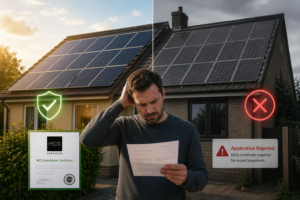
The final and arguably most critical stage is commissioning — where the completed system is tested, calibrated, and formally signed off. Your installer must hold MCS (Microgeneration Certification Scheme) accreditation, and the installation must be registered on the MCS database. Without this certification, you are ineligible for the Smart Export Guarantee (SEG), which pays you for surplus electricity exported to the grid.
In practice, a reputable installer handles all paperwork on your behalf. However, always confirm you receive your MCS certificate before final payment is released — it is your proof of quality, your warranty trigger, and your passport to export income.
With your system live and certified, the next logical question becomes: how do you ensure it performs at its absolute peak? The answer increasingly lies not just in the panels themselves, but in the smart technology layered around them — battery storage, intelligent inverters, and AI-driven energy management that can transform a good solar investment into an outstanding one.
Maximising Efficiency: Battery Storage and Smart Tech
With your solar power panel installation complete and your system generating clean energy, the question shifts from production to performance. Generating electricity is only half the equation — what happens to surplus energy you don’t immediately use determines whether your system truly pays its way.
The Self-Consumption Gap
Most households use the bulk of their electricity in the morning and evening, yet solar panels produce the most power between 10am and 3pm. Without storage, that midday surplus flows back to the National Grid via the Smart Export Guarantee (SEG), which pays as little as 4–6p per unit. You then buy that same electricity back at 24–30p per unit after sunset. That gap — the self-consumption deficit — quietly erodes your returns year after year.
Self-consumption rate: The percentage of solar-generated electricity used directly within your home, rather than exported to the grid. A higher rate means a stronger ROI.
In practice, an unoptimised solar system with no storage achieves a self-consumption rate of roughly 30–40%. Add a battery, and that figure can climb above 80%.
Solar Batteries: Storing Your Own Sunshine
Solar batteries capture surplus daytime generation and release it during evening peak hours, eliminating unnecessary export at low rates. Systems such as Tesla Powerwall and GivEnergy are among the most widely installed in the UK, offering capacities from 5kWh to 13.5kWh. For a typical three-bedroom home, a 10kWh battery comfortably covers evening and overnight demand across most of the year.
Battery costs have fallen significantly and, critically, solar panel ROI improves measurably when storage is factored into the system design from the outset rather than added retrospectively.
Smart Inverters and AI-Driven Tariffs
Smart inverters don’t just convert DC electricity to AC — they communicate with your home, your grid connection, and increasingly, your energy tariff. Paired with intelligent tariffs such as Octopus Flux, your system can automatically charge batteries from the grid during cheap overnight rates and discharge during expensive peak windows, effectively playing the energy market on your behalf.
Future-Proofing for EV Integration
A well-designed system today should anticipate tomorrow’s demands. EV-ready solar systems incorporate a higher-capacity inverter and sufficient battery headroom to charge an electric vehicle overnight from stored solar energy — reducing your transport costs alongside your energy bills.
The strategic value of a well-optimised solar system extends well beyond monthly savings, and it’s worth considering how that improved energy profile affects something equally important: your property’s market value.
The Resale Reality: Does Solar Help or Hinder a Sale?
One concern that resurfaces in almost every homeowner conversation is whether solar panels complicate a property sale. The short answer: when your system is owned outright, the evidence points firmly in the opposite direction.
Owned vs. Leased: Why Ownership Is Everything
The distinction between an owned solar system and a leased system is critical here. An owned installation — the standard outcome when you’ve paid the solar panel cost UK homeowners typically face upfront, or cleared a finance agreement — transfers seamlessly to the new owner as part of the property. A leased system, by contrast, can create legal complications that do occasionally slow conveyancing. If you’ve followed the advice in earlier sections and purchased your system outright, this concern simply doesn’t apply.
The EPC Effect on Property Value
EPC (Energy Performance Certificate): A rating from A to G that measures a property’s energy efficiency, required for any home sale or rental in the UK.
A well-installed solar array, particularly one paired with battery storage, routinely pushes properties from a D or C rating up to a B — sometimes even an A. This matters enormously in 2026’s market, where mortgage lenders increasingly favour high-rated properties and buyers factor running costs into their offers. A higher EPC rating is now a tangible negotiating asset, not merely a compliance tick-box.
Warranties and SEG Contracts Transfer Too
Both panel and inverter warranties are transferable to new owners, as are Smart Export Guarantee (SEG) contracts — the agreements that allow households to sell surplus energy back to the grid. Informing your solicitor early ensures these documents are included in the sale pack without delay.
Solar as a 2026 Buyer Expectation
Buyer attitudes have shifted markedly. What was once considered a premium feature is rapidly becoming a baseline expectation — particularly among buyers prioritising lower bills and energy security. Properties with solar are spending fewer days on the market, and the “difficult to sell” myth is losing credibility fast.
Of course, realising these resale benefits starts long before you list the property — it starts with choosing the right installer in the first place. In the next section, we look at how to separate trustworthy professionals from those who could undermine your investment entirely.
Vetting Your Installer: Avoiding the ‘Cowboy’ Trap
Choosing the right installer is arguably as consequential as choosing the right panels. The UK solar market has grown rapidly, and with growth comes an influx of under-qualified traders targeting homeowners who are enthusiastic but under-informed.
MCS Accreditation: Non-Negotiable
MCS (Microgeneration Certification Scheme): A nationally recognised quality standard that certifies both products and installers in the small-scale renewable energy sector.
MCS accreditation is the baseline requirement — full stop. Without it, you cannot access the Smart Export Guarantee, and any warranties or finance agreements may be legally unenforceable. Always verify an installer’s MCS certificate number independently on the official MCS database before signing anything.
Consumer Protection Memberships
Beyond MCS, look for membership of either RECC (Renewable Energy Consumer Code) or HIES (Home Insulation and Energy Systems). These schemes provide deposit protection, guaranteed dispute resolution, and independent oversight — essential safeguards whether you’re commissioning panels alone or a full solar battery storage installation.
Reading the Small Print on ‘0% Finance’
0% finance offers are rarely as straightforward as advertised. Examine the total contract value, early repayment terms, and what happens if the installer ceases trading. A compelling monthly figure can obscure a significantly inflated system cost.
Local Versus National Installers
National firms offer brand recognition; local installers typically deliver faster response times for maintenance and aftercare. In practice, a well-reviewed regional installer with a strong local reputation often outperforms a large national operator on post-installation service.
Solar installation is a long-term relationship — vet your installer with the same rigour you’d apply to any major home investment.
Key Takeaways
4kW system: £5,000–£7,000 fully installed, suitable for a smaller semi-detached or household of 2–3 people
6kW system: £7,500–£10,000 fully installed, better suited to larger detached homes with higher consumption
Scaffolding: Often charged separately, typically £300–£600
Structural survey: Required for older properties or unusual roof configurations, £150–£400
Inverter replacement: Inverters typically carry a 10–12 year warranty and cost £500–£1,500 to replace — a near-certain expenditure within the panel lifespan